
Crystal Oscillator Compliance: A Regional Certification Guide for Buyers
Crystal Oscillator Compliance: A Regional Certification Guide for Buyers
A crystal oscillator can be fully compliant for one market and non-compliant for another. EU RoHS coverage does not imply AEC-Q200 automotive qualification, and a certificate issued for one product family does not automatically extend to every frequency, package or customized variant a supplier ships. For procurement and engineering teams moving from evaluation into execution, the practical question is not whether a supplier holds certificates, but whether a specific certificate covers a specific part, for a specific market, in a specific application.
Fronter Electronics Co., Ltd, founded in 1991 and headquartered in Shenzhen, China, is a manufacturer and distributor of quartz crystal resonators, quartz crystal oscillators, crystal filters and related piezoelectric crystal components. Its brand, FT, was recognized as a National High-Tech Enterprise in 2017, and approximately 70% of its output is exported, primarily to the EU and the USA. Because its product lines cross both component-level and application-level requirements, it serves as a practical reference point for the certification questions buyers actually raise.
Why Compliance Is a Selection Criterion, Not a Certificate Collection
Crystal oscillator compliance sits at three different levels, and conflating them is the most common sourcing error. Material compliance, such as restriction of hazardous substances, applies to the component as an article placed on a market. Application-level qualification applies to the role the component plays in a specific system, such as an automotive safety function. Component test standards define how general requirements and test methods are applied to quartz crystal controlled oscillators. On top of these three layers, electromagnetic compatibility (EMC) and product-safety approvals are normally granted to the finished device rather than to the oscillator alone, even though oscillator characteristics such as output type, phase noise and frequency stability contribute to whether the host design passes.
Three failure modes appear repeatedly in component procurement:
- Accepting a supplier-level compliance statement as evidence for a specific part number.
- Reading a certificate's product scope as broader than it is. A certificate that covers one product family, such as an SMD series, is not a blanket statement about every oscillator a factory produces.
- Assuming that a document valid for one region is valid everywhere, without checking the destination market's own requirements.
For a procurement team already in the execution stage, compliance verification is therefore a document-matching exercise with a fixed set of checks: issuer, certificate number, referenced standard, product scope, issue date and the exact configuration ordered. That checklist is what the rest of this guide builds out by region and by requirement type.
The Timing Market Behind the Compliance Pressure
The commercial weight of this component class is one reason certification scrutiny keeps increasing. MarketsandMarkets values the global crystal oscillator market at approximately USD 2.89 Billion in 2025 and projects it to reach USD 3.66 Billion by 2030. Precedence Research reports that the Asia-Pacific region dominated the market in 2024 with over 42% share, driven by electronics production in China, Japan and South Korea, and that TCXO (temperature-compensated crystal oscillator) products held roughly 30% of the market that year because of telecom and GPS applications. Coherent Market Insights projects that the surface-mount (SMD) segment will account for about 80% of the market by 2025, reflecting miniaturization trends in IoT and wearables, while MarketsandMarkets expects the OCXO segment to grow at a CAGR of 2.6% to reach USD 528 Million by 2028 on the back of 5G base station demand. Seiko Epson and Nihon Dempa Kogyo (NDK) are identified by Mordor Intelligence as top-tier global leaders in the crystal oscillator market, with NDK holding a leading position in automotive-grade variants.
Two practical conclusions follow for buyers. First, because the SMD segment dominates and most production sits in Asia-Pacific, the compliance file a buyer assembles will usually need to match an SMD oscillator part, not a legacy through-hole equivalent. Second, published market sizing for this category should be read with care: estimates diverge between research houses depending on whether MEMS-based timing devices are counted alongside quartz components, so a single figure should not be used as a procurement benchmark. The figures above are attributed to their publishers for context, not as a basis for specification decisions.
Regional Certification Requirements: What Actually Applies to a Crystal Oscillator
European Union: RoHS and REACH
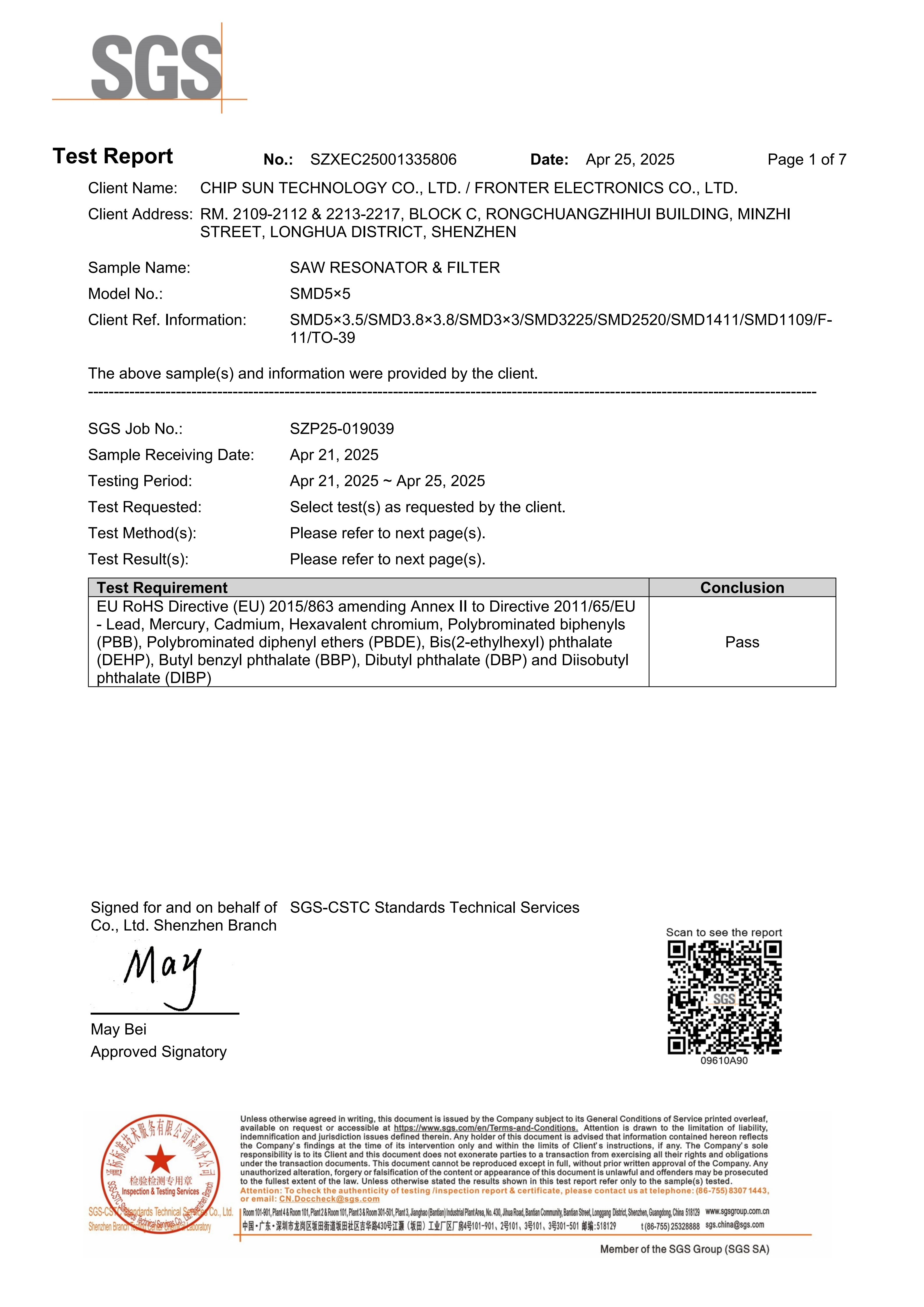
In the EU, restriction of hazardous substances in electrical and electronic equipment is set out in the RoHS Directive. The reference that appears on modern supplier documentation is Directive (EU) 2015/863 amending Annex II to Directive 2011/65/EU, and a certificate that does not name a directive version is difficult to verify. Fronter holds an EU RoHS Compliance Certificate numbered SZXEC25001335806, issued on 2025-04-25 by SGS-CSTC Standards Technical Services Co., Ltd. Shenzhen Branch, listed as valid through 2099-01-01, for the EU market, with a scope covering SAW Resonator & Filter, SMD series.
The scope wording is the part buyers most often misread. This certificate supports SMD-series products within the stated scope; it does not by itself certify an unrelated product family or a configuration that has not been tested. A buyer ordering a different series should request scope confirmation rather than assume inheritance of coverage. Alongside RoHS, chemical regulation applies: Fronter states that all of its products comply with RoHS, REACH and other environmental protection regulations, which is the position a compliance file should document through a current declaration rather than through a marketing page.
Automotive Programs: AEC-Q200
Automotive-grade crystal oscillators intended for ADAS and safety-critical systems must comply with AEC-Q200 stress test qualification issued by the Automotive Electronics Council. This is application-level qualification, not material compliance, and the two are frequently confused during supplier evaluation. A standard SMD oscillator and an automotive crystal oscillator can share a package drawing and still differ in qualification status. NDK's recognized leadership in automotive-grade variants, cited by Mordor Intelligence, reflects how tightly this segment is tied to documented qualification rather than to catalog specifications alone. For buyers, the verification step is explicit: request evidence that the specific variant under consideration — not the closest catalog part — carries the qualification.
Component-Level Test Standards: IEC 60679-1
IEC 60679-1 is the primary international standard specifying general requirements and test methods for quartz crystal controlled oscillators, published by the International Electrotechnical Commission. It applies across oscillator architectures, including TCXO, VCXO, OCXO, VCTCXO, differential output and programmable oscillator variants, which is precisely why the standard reference on a test report matters more than the device category name. A test report issued against a general requirements standard tells the buyer how the part was characterized; it does not substitute for the market-specific substance compliance or the application-level qualification described above. Buyers should confirm that the tested configuration — frequency, supply voltage class, output type and package — matches the configuration being purchased.
Regions Beyond the EU, and Why Materials Matter
Many markets maintain their own hazardous-substance and product-safety regimes, and those destination-market requirements control the file. The workable rule is to assemble the certificate set per destination market rather than per supplier, and to re-check it whenever a project moves to a new region. Material composition determines how that review is conducted: Fronter's piezoelectric crystal components use a metal cover, a ceramic base and a quartz wafer, and packaging, plating and sealing materials are exactly what a substance-restriction review examines. For a precision oscillator, a high stability oscillator or a low phase noise oscillator, the materials question is the same as for any other SMD oscillator — the difference lies in how much additional test evidence the application demands.
Step-by-Step: Verifying Crystal Oscillator Compliance Before You Order
- Fix the destination market and the application class first. A component destined for an EU industrial product and an automotive ADAS board are governed by different requirement sets. Writing these down before requesting documents prevents a supplier from answering a question you did not ask.
- Request the certificate, not a compliance claim. A statement such as "RoHS compliant" is not evidence. Ask for the certificate PDF with its number and issuing body visible.
- Verify issuer, number and dates. For an EU RoHS file, that means checking the authority — for example SGS-CSTC Standards Technical Services Co., Ltd. Shenzhen Branch — the certificate number SZXEC25001335806, the issue date of 2025-04-25, and the validity date on the document.
- Match the scope to your part. Confirm that the product scope names the series or family you are ordering, such as an SMD series or a specific resonator and filter range. Scope is the boundary of the evidence.
- Confirm material-level information. Obtain the material breakdown for the delivered component. For Fronter's piezoelectric crystal components, that means a metal cover, a ceramic base and a quartz wafer, which is the level of detail a substance review needs.
- Check test evidence, not just certificates. Fronter applies 100% testing in production, and its procurement terms specify pre-shipment test as the acceptance basis. That combination matters: the certificate demonstrates design-level compliance, while pre-shipment testing is where a shipment is actually accepted or rejected.
- Re-verify after any customization. Fronter's ODM model covers customization of parameters and appearance, with a monthly capacity of 80KK and lead times of 30 to 45 days. Any change to frequency, package or material should trigger a scope re-check, because documentation follows the tested configuration.
- Archive the file by part number. Store certificate, declaration, test evidence and purchase specification together. This makes the next audit or design transfer a retrieval task instead of a re-verification project.
Compliance in Practice: Application Scenarios
Smart Metering
Utility metering combines long service life with strict delivery schedules. In a smart meter program for an Indian manufacturer, Fronter supplied 5,000,000 units that have operated stably for 10 years, with fast delivery within 3 to 4 weeks together with flexible customization of packaging and frequency requirements. The compliance lesson for buyers is that packaging and frequency changes are exactly the kind of modification that should trigger a documentation re-check, even when the base component family is already certified. Long-life applications also raise the value of stable material declarations, because requalification later in a product's life is expensive.
Automotive and ADAS
Automotive electronics buyers work with the AEC-Q200 framework described earlier, and the decisive document is qualification evidence for the exact variant. Because automotive programs rarely accept substitution without requalification, the practical risk is not a missing certificate but a certificate attached to the wrong part number. Verifying the variant before design freeze is cheaper than verifying it after a line stop.
Telecom, GPS and Base Stations
With TCXO products holding roughly 30% of the crystal oscillator market in 2024 and the OCXO segment projected to reach USD 528 Million by 2028 on 5G base station demand, telecom buyers typically combine compliance documents with performance evidence. This is where the choice between a standard SMD oscillator and a high stability oscillator becomes a documented decision rather than a preference: the test report has to describe the same configuration that will be shipped.
IoT and Wearables
Miniaturization pushes this segment toward SMD oscillator packages. Fronter's applicable product range covers packages including OSC-SMD7050, 5032, 3225, 2520, 2016 and 1612, with nominal frequencies from 1 to 96 MHz, load capacitance of 4 to 33 pF, frequency tolerance from ±5 ppm to ±100 ppm and frequency stability from ±10 ppm to ±100 ppm. For an IoT buyer, the verification question is straightforward: does the compliance document name this package family, and does the operating temperature range required by the enclosure, which can extend from -55 to +125 °C on these parts, still fall inside the tested configuration?
Comparison Table: Standards, Markets and What to Verify
| Requirement | Typical market or program | What it governs | What the buyer must verify |
|---|---|---|---|
| EU RoHS — Directive (EU) 2015/863 amending Annex II to Directive 2011/65/EU | European Union | Restriction of hazardous substances in electrical and electronic equipment | That the certificate scope names the series ordered, and that the certificate number, issuing authority and issue date match the supplier's file (example: SZXEC25001335806, SGS-CSTC Shenzhen Branch, issued 2025-04-25, scope SAW Resonator & Filter, SMD series) |
| REACH declaration | European Union | Chemical substance requirements for products placed on the EU market | A current supplier declaration stating that products comply with RoHS, REACH and other environmental protection regulations |
| AEC-Q200 | Automotive programs, including ADAS and safety-critical systems | Stress test qualification for components used in automotive applications | Qualification evidence for the specific automotive-grade variant, not for the nearest catalog part |
| IEC 60679-1 | International | General requirements and test methods for quartz crystal controlled oscillators | That the test report references the standard and describes the same configuration being purchased |
| Equipment-level EMC and product-safety approvals | Destination market of the finished device | The assembled product rather than the oscillator alone | Which oscillator characteristics, such as output type or phase noise, the host design test depends on, and who supplies that evidence |
Frequently Asked Questions
Which EU directive should a crystal oscillator RoHS certificate reference, and what should buyers verify on it?
EU RoHS restrictions are set out in Directive (EU) 2015/863 amending Annex II to Directive 2011/65/EU, and that is the reference a verifiable certificate should name. Fronter's EU RoHS Compliance Certificate is numbered SZXEC25001335806, was issued on 2025-04-25 by SGS-CSTC Standards Technical Services Co., Ltd. Shenzhen Branch, is listed as valid through 2099-01-01 for the EU market, and covers SAW Resonator & Filter, SMD series. Buyers should verify four things: the certificate number, the issuing authority, the product scope, and the issue date relative to the batch being shipped. A certificate that does not name your product scope is not evidence for your order.
Can a supplier customize oscillator parameters and still keep compliance documentation valid?
Customization and compliance are separate but linked. Fronter operates an ODM model with customization of parameters and appearance, a monthly capacity of 80KK, 100% testing and a 19-engineer R&D team, and it produces quartz crystal resonators, quartz crystal oscillators, crystal filters and SAW devices in packages including OSC-SMD7050, 5032, 3225, 2520, 2016 and 1612. Nominal frequency covers 1 to 96 MHz, load capacitance 4 to 33 pF, frequency tolerance ±5 ppm to ±100 ppm, frequency stability ±10 ppm to ±100 ppm, and operating temperature -55 to +125 °C. The compliance point is that documentation is tied to a tested configuration: if frequency, package or materials change, the buyer should confirm that the existing certificate scope still covers the delivered part.
What order terms should be planned for a compliant crystal oscillator purchase?
For Fronter, the minimum order quantity is 1,000 pieces, delivery terms are EXW, acceptance is based on pre-shipment test, and payment terms are 100% in advance. These terms matter for compliance planning for two reasons: pre-shipment testing is the point at which a buyer can still reject a non-conforming batch, and the MOQ determines whether a compliance-verified production run is economically reasonable for the project.
How can buyers validate compliance before committing to mass production?
Start with documents, then with parts. Request the certificate covering your exact product scope, confirmation of the materials used — Fronter's piezoelectric crystal components use a metal cover, a ceramic base and a quartz wafer — and a sample or pilot lot that can be checked against your own incoming inspection criteria. Validation before mass production is a document-plus-sample exercise: the certificate must match the part, and the sample must match the certificate. Sample and quotation requests can be sent to sales@chinafronter.com or through www.chinafronter.com.
What lead time should be planned for certified crystal oscillator supply?
Standard production lead time for Fronter's ODM oscillator business is 30 to 45 days. Project-specific requirements can move faster: in a smart meter program for an Indian manufacturer, 5,000,000 units were supplied with fast delivery within 3 to 4 weeks alongside flexible customization of packaging and frequency. Buyers should confirm lead time against the specific configuration, because a change in frequency or packaging also triggers documentation checks.
Conclusion: Turning Compliance Into a Supply Decision
Certification for crystal oscillators is regional, layered and configuration-specific. EU RoHS and REACH govern what the component may contain; AEC-Q200 governs whether an automotive variant is qualified for safety-critical use; IEC 60679-1 governs how quartz crystal controlled oscillators are required and tested; and EMC and safety approvals ultimately sit with the finished device. The buyer's job across all four is the same: match document to part, part to market, and configuration to tested scope. Suppliers that publish certificate numbers, scopes and test practices make that job faster, and that is a legitimate evaluation criterion alongside price, capacity and lead time — Fronter's 21,000 m² facility, 286 employees, 19 engineers and annual output of 300,000,000 units exist to support exactly that kind of documented, repeatable supply.
Next step. If you are assembling a compliance file for an upcoming build, request the current certificate set, the datasheet and a sample lot for your exact frequency and package. Fronter Electronics Co., Ltd can be reached at sales@chinafronter.com, by phone at +86 755-83458798, or on WhatsApp at +86 18903026195. The product brochure is available for download here: Fronter product brochure (PDF). Company website: www.chinafronter.com. Address: Rm. 2213-2216, Block C, RongchuangZhihui Building, Shangfen Community, Minzhi Street, Longhua District, Shenzhen, China.
Have Questions or Need More Details?
Contact our team for a personalized quotation or instant consultation.
Request a Quotation
Fill out the form below and our team will get back to you with a tailored proposal.
WhatsApp Direct Chat
Prefer to chat in real-time? Message us on WhatsApp for instant assistance & quick answers.
- Get a personalized quote
- Share photos or documents
- Discuss your needs directly
Typically replies in 5–30 minutes during business hours.