
Technical Guide to Crystal Resonators: Decoding Specs for Piezo Elements and Quartz Crystals
Crystal resonators are piezoelectric-based frequency control components used in precision timing applications. At the centre of the device sits a quartz wafer — a piezo element that vibrates at a mechanically defined frequency when voltage is applied across it, and in doing so supplies a stable clock signal to an integrated circuit. The datasheet attached to that component is where a project is either secured or exposed: frequency tolerance, load capacitance, frequency stability, operating temperature and package all interact, and misreading any one of them surfaces later as drift, a failed timing budget, or a redesign during production.
This technical guide is written for engineers and procurement professionals working through the research and evaluation stage of a project. It decodes the parameter set behind quartz crystals and other piezo elements — without reference to specific part numbers — and explains how to map each specification onto a real application requirement. The product data referenced here is that of Fronter Electronics Co., Ltd, a Shenzhen-based manufacturer founded in 1991 whose main products are quartz crystal resonators and quartz crystal oscillators.
Problem Definition: Why Crystal Resonator Specifications Get Misread
Most crystal resonator selection failures are not caused by a defective component. They are caused by a specification read in isolation. A parameter that looks adequate in the first table of a datasheet can be the wrong value once the oscillator circuit, the temperature profile and the production process are considered together.
- Tolerance is confused with stability. Frequency tolerance describes the permitted deviation at a defined reference condition; frequency stability describes how far the frequency moves across the operating temperature range. Across Fronter's quartz crystal components, frequency tolerance is specified from ±5 ppm to ±100 ppm and frequency stability from ±10 ppm to ±100 ppm — two separate numbers that must be added into one error budget, not substituted for each other.
- Load capacitance is treated as a formality. A crystal oscillates at its nominal frequency only at a specific load capacitance (4–33 pF across the Fronter quartz crystal component range). If the oscillator circuit presents a different load, the resonant frequency is pulled away from nominal — a deviation that no amount of incoming inspection screening will reveal.
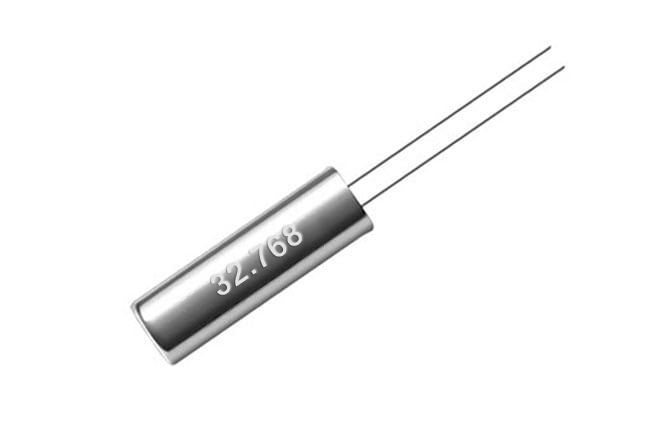
- Temperature range is assumed rather than checked. A 32.768 kHz tuning fork crystal rated from −40 °C to +85 °C and an MHz quartz crystal rated from −55 °C to +125 °C are not interchangeable in a high-temperature working condition, even though both are described simply as quartz crystal resonators.
- A tighter grade is mistaken for a better component. Over-specification is a genuine cost driver: a wider temperature grade or a tighter stability window that the project cannot use adds cost and often lengthens supply.
The consequence is a familiar sequence in evaluation projects: sample approval passes on the bench, first production drifts, and the root cause traces back to a parameter that was never matched to the application.
Industry Background: Piezo Elements, Quartz Crystals and Precision Timing
The crystal resonator is one of the oldest and most durable applications of the piezoelectric effect. A thin quartz wafer — the piezo element — is mounted between electrodes inside a protective enclosure. Applied voltage causes the wafer to vibrate at a mechanically determined frequency, and that vibration is converted back into an electrical signal. Its function is constant and simple to state: provide a stable clock signal for the IC. The operating mode is vibration, and the component is matched to an oscillator circuit inside the end product.
Construction details matter when a buyer is evaluating robustness rather than unit price. Fronter's quartz crystal components use a quartz wafer, a metal cover and a ceramic base; the 32.768 kHz tuning fork family uses gold, SiO₂ and silver in its construction. These are the physical layers that determine how the device behaves under thermal cycling and mechanical stress.
Two published standards frame how specifications should be interpreted:
- IEC 60122 series — the international baseline for quartz crystal units, covering general requirements and measuring methods. When comparing datasheets from different suppliers, the measurement conditions described by this series are the reference point for deciding whether two tolerance figures are genuinely comparable.
- AEC-Q200 — the global stress resistance standard required for passive electronic components, including crystal resonators, in automotive applications. It defines a qualification path rather than a single parameter.
Market context explains why specification literacy carries commercial weight. The global crystal oscillator market was valued at USD 2.89 billion in 2025 and is projected to reach USD 3.66 billion by 2030 (MarketsandMarkets). Asia Pacific accounted for more than 42% of revenue in 2024, approximately USD 1.1 billion (Precedence Research), and automotive applications are expanding at a CAGR of 12.88%, driven by ADAS, infotainment and EV powertrains (Fortune Business Insights). Automotive-grade processes are led by large established manufacturers — among the recognised top global suppliers of quartz crystals and oscillators are Seiko Epson, Nihon Dempa Kogyo (NDK), Kyocera, Daishinku (KDS) and TXC Corporation (Mordor Intelligence). Silicon MEMS represents the emerging alternative path: SiTime introduced the SiT1811, a 32.768 kHz oscillator drawing 510 nA, in 2024 for ultra-low-power IoT and wearables. For most industrial and consumer projects, however, the quartz crystal resonator remains the reference solution, and the specification sheet remains the decision document.
Detailed Solution: The Parameter Set That Determines Project Fit
Decoding a crystal resonator datasheet means translating eight parameters into project requirements. Each one below is stated with the range that Fronter's quartz crystal components operate within, followed by the decision it drives.
1. Nominal Frequency and Mode
Frequency determines the resonator family. The 32.768 kHz tuning fork family is the timekeeping reference — 32.768 kHz is a power-of-two division of one second, which is why it appears in real-time clock circuits. The MHz family, specified from 1 MHz to 96 MHz across Fronter's quartz crystal components, serves system clocks, communication electronics and RF stages. Choosing the frequency is not a free decision: it fixes the available package formats, the achievable tolerance and, in most designs, the oscillator circuit topology.
2. Frequency Tolerance
Tolerance is the permitted deviation from nominal frequency at the reference condition. Across the Fronter quartz crystal component range the specified window is ±5 ppm to ±100 ppm, while the 32.768 kHz tuning fork family is specified at ±20 ppm. The practical question is not how tight a tolerance can be achieved, but what the timing budget actually allows. A ±5 ppm grade applied to a circuit that can absorb ±50 ppm over its service life is cost added without benefit.
3. Frequency Stability
Stability is the change in frequency across the operating temperature range, specified from ±10 ppm to ±100 ppm across Fronter's quartz crystal components. Tolerance and stability are additive in the worst case, and both must be combined with load-capacitance pull and long-term aging to reach a total error figure. Stability is the parameter that most often invalidates an otherwise attractive sample: a part that performs excellently at room temperature can still fail an outdoor or in-cabinet installation.
4. Load Capacitance
Load capacitance is the parameter most frequently under-specified at the design stage. Fronter's quartz crystal components are specified across 4–33 pF, and the 32.768 kHz tuning fork family is offered at 12.5 pF, 7 pF and 9 pF. The crystal and the oscillator circuit form a resonant system: if the circuit's effective load capacitance differs from the value the crystal was specified at, the oscillation frequency is pulled off nominal, and the error appears as a constant offset that survives every other screening step. Matching load capacitance is a design task, not a purchasing task — but confirming that the purchased specification matches the design intent is a purchasing responsibility.
5. Operating Temperature Range
The two quartz families differ here in a way that maps directly onto application. The 32.768 kHz tuning fork family is rated from −40 °C to +85 °C, while the broader quartz crystal component range is rated from −55 °C to +125 °C. The evaluation question is where the component actually sits — inside a handheld device, behind a panel in a smart energy meter, or adjacent to an automotive powertrain. The stated working condition, not the product category, decides which of these windows is required.
6. Package and Mounting Format
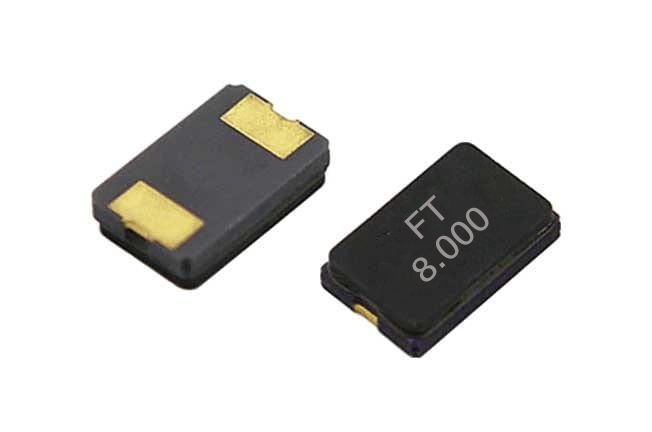
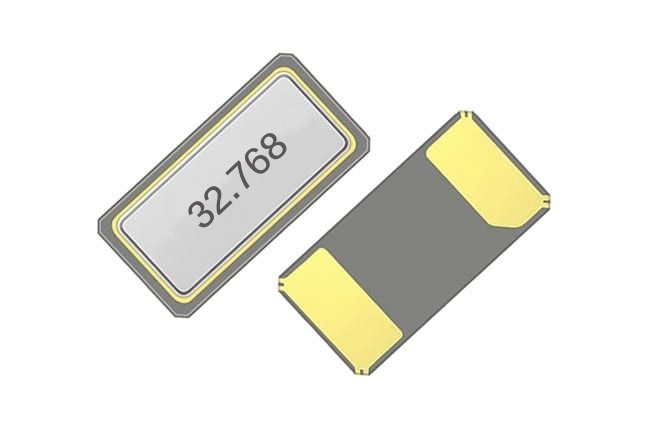
Package choice follows the assembly process. Fronter's quartz crystal components cover SMD sizes including 7050, 6035, 5032, 3225, 2520, 2016 and 1612, while the 32.768 kHz tuning fork family is offered in 1.6 × 1.0 mm, 2.0 × 1.2 mm and 3.2 × 1.5 mm surface mount formats. Through-hole and cylindrical formats remain in use where the board is not reflow-assembled, or where mechanical retention matters more than footprint. Package size is also a stability decision, because a smaller package constrains the internal geometry of the quartz wafer.
7. Materials and Construction
Construction is the substrate beneath every parameter above. Metal cover, ceramic base and quartz wafer determine thermal behaviour and sealing quality; gold, SiO₂ and silver in the tuning fork family relate to electrode and plating quality. When two suppliers quote identical tolerance figures, construction is often the reason their field performance diverges.
8. Parameters to Request Beyond the Standard Sheet
A datasheet is a summary, not a complete qualification record. Before approval, ask the supplier for the measurement conditions behind each figure, and for data on aging behaviour per year, equivalent series resistance and drive level, plus batch-level test traceability. Fronter applies 100% testing on its crystal resonator production. Requesting these items is not a sign of distrust — it is the standard basis for comparing two apparently identical specifications.
Step-by-Step Breakdown: Decoding a Datasheet for a Specific Project
- Define the timing function first. Is the resonator providing timekeeping, a system clock or a communication reference? The function determines the frequency family before any datasheet is opened.
- Build a frequency error budget. Add tolerance, stability over temperature, load-capacitance pull and expected aging into a single total. Approve a part only if the total sits inside the system's timing allowance.
- Match load capacitance to the oscillator circuit. Confirm the value the crystal is specified at and the value the circuit presents. Resolve the difference in the design, not in the purchase order.
- Screen the temperature window against the real working condition. Use the installation environment, not the product category. For automotive and other high-stress environments, this is where AEC-Q200 enters the qualification plan.
- Select the package for the assembly line. SMD sizes for reflow, through-hole or cylindrical where the process requires it, with board space and mechanical retention checked against the formats available for the chosen frequency family.
- Confirm the test and quality method. Establish what the supplier tests, at which stage, and with what documentation — Fronter's crystal resonator production applies 100% testing.
- Validate with samples before volume commitment. Sample evaluation under the project's own conditions, including temperature, is the only reliable way to confirm that the decoded specification matches reality.
- Confirm commercial terms against the project schedule. Fronter's standard MOQ is 1,000 pcs, lead time is 30–45 days, monthly capacity is 80KK, and ODM customization covers both parameters and appearance — terms that should be checked against the production ramp rather than assessed in isolation.
Use Cases: Where Specification Choices Change the Outcome
Smart Metering and Energy Infrastructure
A smart meter manufacturer in India has purchased 5,000,000 units of Fronter quartz crystal components for smart meter applications across a ten-year relationship, with stable operation reported as the result. The project-specific element was not the nominal frequency alone: packaging and frequency requirements were customized to the project, and deliveries were completed within 3–4 weeks. In metering, the governing specifications are the stability window across the outdoor temperature range and load capacitance matching to the metering IC's oscillator circuit.
Consumer Electronics, IoT and Bluetooth Devices
Smart home appliances, communication electronics and Bluetooth devices are the primary application fields for Fronter's quartz crystal components, while the 32.768 kHz tuning fork family serves consumer electronics, IoT, smart energy meters and automotive devices. Typical end products include mobile devices, Bluetooth headsets, smart air conditioners and security cameras, deployed in markets including Germany, Russia, India, Canada, France, Italy, Spain and South Korea. For these projects, the governing specifications are package size, load capacitance — 7 pF, 9 pF or 12.5 pF — and the ±20 ppm tolerance window.
High-Temperature and Automotive Environments
Where the working condition is high temperature, the specification conversation changes. The wider −55 °C to +125 °C window and AEC-Q200 qualification take priority over package miniaturisation, and the error budget must be built around the temperature extremes. Automotive crystal applications continue to expand globally at a CAGR of 12.88%, driven by ADAS, infotainment and EV powertrains.
Comparison Table: Tuning Fork vs. MHz Quartz Crystal Resonators
The two quartz families are frequently compared as if one were an upgrade of the other. They are not: they serve different timing functions, and the specification differences below are the reason a project selects one rather than the other.
| Specification | 32.768 kHz tuning fork quartz crystal resonator | MHz quartz crystal resonator |
|---|---|---|
| Nominal frequency | 32.768 kHz | 1–96 MHz |
| Frequency tolerance | ±20 ppm | ±5 ppm to ±100 ppm |
| Frequency stability | Not published in the same range — request supplier data | ±10 ppm to ±100 ppm |
| Load capacitance | 12.5 pF / 7 pF / 9 pF | 4–33 pF |
| Operating temperature | −40 °C to +85 °C | −55 °C to +125 °C |
| Package formats | SMD 1.6 × 1.0 mm, 2.0 × 1.2 mm, 3.2 × 1.5 mm | SMD 7050 / 6035 / 5032 / 3225 / 2520 / 2016 / 1612 |
| Construction materials | Gold, SiO₂, silver | Quartz wafer, metal cover, ceramic base |
| Typical applications | Consumer electronics, IoT, smart energy meters, automotive | Smart home appliances, communication electronics, Bluetooth devices |
Specifications as published for the Fronter Electronics quartz crystal components and the 32.768 kHz tuning fork family. Values are ranges across each product family, not a single part number.
Frequently Asked Questions
1. Which standards apply to quartz crystal resonators in automotive and industrial projects?
The IEC 60122 series provides the international baseline for quartz crystal units, covering general requirements and measuring methods, and is the reference point for comparing measurement conditions between suppliers. For automotive applications, AEC-Q200 is the global stress resistance standard required for passive electronic components, including crystal resonators. On the materials side, Fronter Electronics states that all of its products comply with RoHS and REACH environmental protection regulations.
2. Can a supplier customize frequency and load capacitance for a specific project?
Yes, within the manufacturing window. Fronter Electronics works in ODM mode, with customization covering both parameters and appearance, supported by a monthly capacity of 80KK and a 19-engineer R&D team. Customizable parameters include nominal frequency, load capacitance, frequency tolerance and stability, and operating temperature. Customization is most effective when the project's error budget is supplied along with the request, because the supplier can then confirm which parameter combinations are producible.
3. Does a tighter tolerance or wider temperature range always cost more?
In general, specification grades that demand tighter process control — narrower tolerance, tighter stability, wider temperature range — carry a higher unit cost than standard grades, and matching the grade to the project requirement is the standard way to control cost without compromising the timing budget. Over-specification is common in early evaluation, where a project requests parameters it cannot use. The practical approach is to specify the loosest window that satisfies the total error budget, then confirm with the supplier whether the requested combination is a standard build or requires ODM customization.
4. How should a sample be validated before mass production?
Samples should be evaluated under the project's own operating conditions rather than at room temperature only, with frequency measured at the specified load capacitance and across the temperature window. Because Fronter applies 100% testing on crystal resonator production, the supplier-side test record can be compared against the buyer's measurements to verify that the specification is repeatable in volume. Validation should also cover the physical package — footprint, reflow profile and handling — before the design is frozen.
5. What is the typical MOQ and lead time for a crystal resonator project?
Fronter's standard MOQ is 1,000 pcs and standard lead time is 30–45 days, with after-sales support delivered remotely. Where a project requires faster delivery, this must be agreed at the quotation stage: in the smart meter case described above, deliveries were completed within 3–4 weeks with packaging and frequency customized to the project. To confirm feasibility, samples and commercial terms for a specific configuration, contact the team at sales@chinafronter.com, message +86 18903026195 on WhatsApp, or download the product brochure.
Specifications decoded — ready to validate them on your project?
Send your frequency, load capacitance, tolerance and operating temperature requirements to Fronter Electronics Co., Ltd and request a sample or quotation for evaluation. Fronter has manufactured quartz crystal resonators and oscillators since 1991, with ODM customization of parameters and appearance, a 1,000 pcs MOQ and a 30–45 day lead time.
Email: sales@chinafronter.com | WhatsApp: +86 18903026195 | Website: www.chinafronter.com | Download the Fronter product brochure (PDF)
Conclusion: Specification Literacy Is Project Fit
Crystal resonators are piezoelectric frequency control components, and their datasheets are decision documents rather than marketing sheets. The evaluation sequence that holds up across projects is consistent: define the timing function, build a total frequency error budget from tolerance, stability, load-capacitance pull and aging, screen the temperature window against the real working condition, match the package to the assembly process, confirm the test methodology, and validate with samples before committing to volume.
Applied to quartz crystals and other piezo elements, that sequence converts a list of parameters into a set of defensible project decisions — and prevents the two most expensive errors in crystal resonator evaluation: buying a grade the project cannot use, and accepting a specification that was never matched to the oscillator circuit.
Fronter Electronics Co., Ltd — founded 1991, Shenzhen, China. Manufacturer of quartz crystal resonators and quartz crystal oscillators. 21,000 m² factory, 286 employees, 300,000,000 units annual output, 19 engineers in R&D, 70% export ratio. Address: Rm. 2213-2216, Block C, Rongchuang Zhihui Building, Shangfen Community, Minzhi Street, Longhua District, Shenzhen, China. Tel: +86 755-83458798. Email: sales@chinafronter.com. Website: www.chinafronter.com
Have Questions or Need More Details?
Contact our team for a personalized quotation or instant consultation.
Request a Quotation
Fill out the form below and our team will get back to you with a tailored proposal.
WhatsApp Direct Chat
Prefer to chat in real-time? Message us on WhatsApp for instant assistance & quick answers.
- Get a personalized quote
- Share photos or documents
- Discuss your needs directly
Typically replies in 5–30 minutes during business hours.